Literacy is the cornerstone of education and a lifelong skill. However, reading requires deliberate instruction, because the human brain is not hardwired to read; we must be taught how to do it.1 “At Havergal, understanding how to teach young students the best early literacy skills has long been a focus of the professional practice of our faculty,” says Seonaid Davis, Vice Principal of Teaching & Learning. As a member of the school’s Senior Leadership Team, Davis’s role is to oversee Havergal’s curriculum development and education practices, while working directly with teachers to support their process.

“Over the years, we have been willing to learn, take risks, reflect critically and shift our thinking to build a strong instructional approach that supports students with wide-ranging needs,” explains Nancy Tulli, Junior School Literacy Coordinator. “While we will never say we are ‘done’ in our learning and development, our efforts have led us to a strategic, research-based and highly effective approach to reading instruction.” This approach is aligned across the Junior School’s early years and primary grades by supporting students in acquiring the foundational reading skills and mindsets they require for future success along their academic journeys.
“Creating a strong reading program to support all students takes a team approach,” says Tulli. It begins in the classrooms with core teachers who understand the science and brain research behind how children learn to read. They bring creativity and enthusiasm to the task and motivate students to do the work necessary to become readers. “Our Junior School Librarian supports students in developing a reading identity, exploring books they love and discovering things about the world beyond the library walls,” says Tulli, noting that parents are their child’s first teachers and are instrumental in nurturing a love of reading and creating an environment that builds the background knowledge and vocabulary to support a reader’s comprehension of what they are reading as they encounter increasingly complex texts.

At Havergal, understanding how to teach young students the best early literacy skills has long been a focus of the professional practice of our faculty.
Seonaid Davis, Vice Principal of Teaching & Learning

This team approach has been particularly necessary in the past few years, as reading teachers have been challenged with a monumental shift in what is recognized as best practice in reading instruction. “Faculties of Education, educational publishers and the Ministry of Education have all overhauled their approach to early literacy instruction,” says Davis. “What was considered best practice for more than 20 years has shifted.” The government released a new language curriculum in June 2024 to reflect these changes and a new kindergarten document is expected to be released before September 2025, revising what and how early literacy skills should be taught. While the changes to Ontario curriculum documents are recent, Havergal College teachers of young readers have collaborated with Tulli in her role as Junior School Literacy Coordinator for three years to understand the research and adopt new instructional models that align with the science of reading. Building on a strong program, teachers are seeing positive results from their efforts, with students demonstrating excellent progress in decoding and spelling due to systematic phonemic awareness and phonics instruction.
“A key to the success of Havergal College’s early reading program is knowing our students as readers,” says Tulli. “What skills have they already acquired that we will build on? How are they progressing with the new skills they have been taught? Are any of their skills lagging?” Careful and strategic assessment in various forms enables the team to build a picture of each student and plan their instruction accordingly across the school year and grades. Student progress is discussed in a collaborative approach between core teachers, the Literacy Coordinator and Learning Support Specialists as they work as a team to help all students acquire key skills. “No student should be languishing in material that offers no new learning opportunities or floundering because she is struggling and not receiving the additional support she needs,” says Tulli.
Learning to read is not a linear journey and some students may need additional time and practice to consolidate skills more than others. “This does not mean we take a wait-and-see approach with students who are not meeting achievement benchmarks,” says Cheryl MacKinnon, Head of Learning Support in the Junior School. The notion of “they will learn to read when they are ready” has proven to be flawed and even harmful to long-term outcomes. For some students, learning to read can be challenging. “If we simply wait for students to be ready to read, we risk losing critical time for their reading development,” explains MacKinnon. For this reason, Havergal’s early years classrooms provide rich learning opportunities that offer all students direct, systematic reading instruction. “Through our robust assessment and screening practices, we can closely monitor the progress of our students to ensure they are making steady growth and identify which students may be at risk for reading challenges,” she says.
Creating a strong reading program to support all students takes a team approach.
Nancy Tulli, Junior School Literacy Coordinator
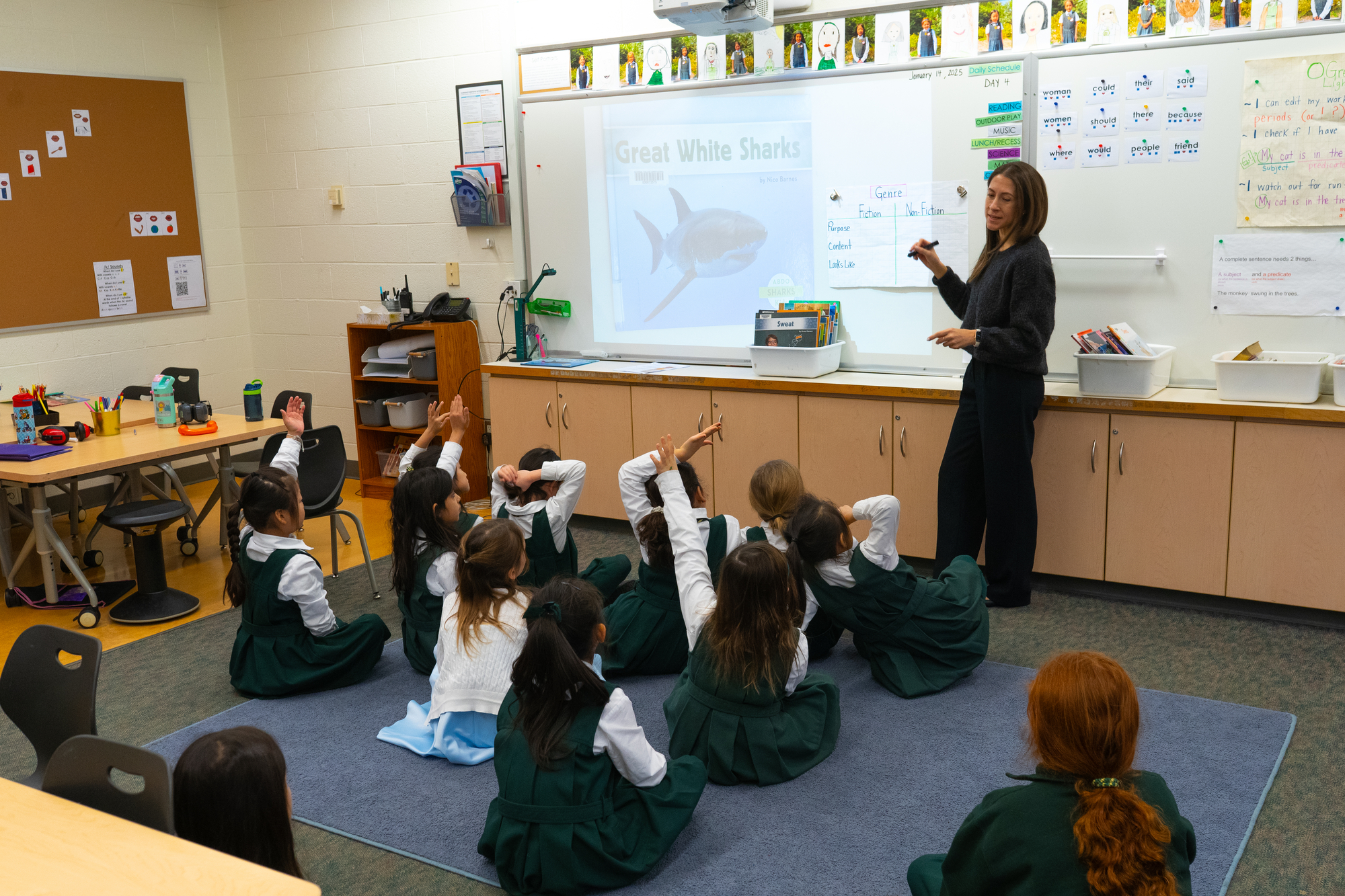
While the importance of early intervention is not a new concept, it is a key tenet in Havergal’s approach to supporting students. “We know the earlier a student receives support for any identified need, whether literacy, mathematics or social-emotional and behavioural development, the better the outcome,” says MacKinnon. Regarding reading difficulties, the likelihood of reaching grade-level expectations declines each year that a child does not receive support, which is why it is so detrimental to wait and see. “This understanding is what drives our early reading intervention programming at Havergal,” she says.
The school’s reading interventions use systematic and direct instruction to support students in developing foundational reading skills. Intervention begins as early as Junior Kindergarten, where students receive targeted small-group instruction to develop pre-reading skills, which lay the foundation for learning to read. Students who do not make sufficient progress despite this targeted support are referred to Havergal’s Learning Support Department for more intensive approaches. “Using evidence-based programming, our Learning Support Specialists work with students in one-on-one or small group settings to target essential skills, such as phonemic awareness, letter-sound correspondence, decoding strategies and reading fluency,” explains MacKinnon.
We know the earlier a student receives support for any identified need, whether literacy, mathematics or social-emotional and behavioural development, the better the outcome.
Cheryl MacKinnon, Head of Learning Support in the Junior School

The collective effort of the Junior School’s Learning Support Specialists and classroom teachers is paying off: they are seeing excellent results in students’ reading abilities throughout the Junior School. “Most of our students leave Grade 3 as fluent readers,” explains Tulli. “By this age, they are ready to shift from learning to read to reading to learn,” she says. The skills they acquire through these comprehensive and intensive support systems from Junior Kindergarten through Grade 3 serve students well as they apply their skills in all of their classes.
Strong readers have endless possibilities at their fingertips. Whether they learn to read through classroom instruction or need additional targeted support, Havergal students are ready to use their skills to better understand their world or to immerse themselves in a world that only exists in a good book.
- “Speaking Is Natural; Reading and Writing Are Not.” Reading Rockets, www.readingrockets.org, Accessed 4 Feb. 2025.
Published April 2025
2024–25 Issue